King Tides in South Florida: What Boaters Should Know
Boating in South Florida means paying attention to changing water conditions, and certain times of the year can bring more noticeable tidal changes. One of those periods is known as a King Tide, when naturally occurring tides can produce higher-than-normal water levels.
King Tides are a normal part of the tidal cycle and don’t mean you need to stay off the water. However, the additional water height and stronger tidal movement in some areas can change conditions around docks, seawalls, bridges, sandbars, inlets and other areas you may regularly visit.
Before heading out, check the day’s tide predictions and keep the timing of high and low tide in mind throughout your reservation.
Are There Extreme Highs and Lows During King Tides?
King Tides are primarily associated with especially high high tides, although the same astronomical conditions can also contribute to a greater tidal range, meaning the difference between high and low water may be more noticeable.
For boaters, what’s important isn’t just the water level when you leave the dock. Think about where the tide will be several hours later. A sandbar, dock, channel or waterfront restaurant that is easy to access at one point in the day may look very different when you return.
Docking at Waterfront Restaurants
Stopping for lunch or dinner by boat is one of the best parts of boating in South Florida, but elevated tides require a little extra awareness.
When approaching a waterfront restaurant or marina, slow down and evaluate the dock before committing to your approach. Higher water can change the relationship between your boat, the dock, pilings and seawalls. Current may also affect how the boat responds as you approach.
Once you’re tied up, consider what the tide is expected to do while you’re there. Make sure lines and fenders are positioned appropriately, and remember that the water level may be different when you return to the boat.
If you’re unsure about the conditions or whether a particular destination is a good option that day, ask our dock team before you leave.
Visiting Sandbars During King Tides
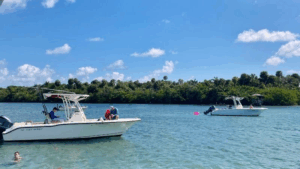
King Tides can also change your experience at popular South Florida sandbars. Areas that are normally shallow may have considerably more water over them at high tide, while conditions can change as the tide begins to fall.
Before anchoring, check your depth and understand whether the tide is rising or falling. Give yourself enough water beneath the boat and enough room to safely depart later.
Most importantly, don’t assume that because you got into an area safely, you’ll automatically be able to get out the same way several hours later. Keep an eye on changing water levels throughout your visit.
What Should You Look Out For?
During periods of unusually high or low water, a little additional situational awareness goes a long way. Pay particular attention to:
- Dock and seawall height: Elevated water can change how you approach, tie up and step on or off the boat.
- Bridge clearance: Higher water means less clearance beneath fixed bridges. Never assume your normal clearance is available.
- Channels and shallow areas: Falling tides can reduce depth, particularly outside marked channels.
- Sandbars: Water depth can change significantly during your stay.
- Currents: Tidal flow may be stronger in inlets, narrow waterways, around bridges and near docks.
- Floating or submerged debris: Higher water can move debris from shorelines and other areas into navigable waterways.
- Your return trip: Always consider what the tide is expected to be when you’re heading back, not just when you depart.
When in Doubt, Ask the Dock Team
You don’t have to figure everything out on your own. Our Gulf Stream Boat Club dockhands are here to help.
If you have questions about the day’s tides, local conditions, a destination you’re considering or anything else before leaving the dock, ask the team. They can help you think through your plans based on current conditions.
Our dock teams are also highly responsive by phone. If something happens while you’re on the water or you’re unsure about a situation, call your local Gulf Stream Boat Club dock phone number. It’s always better to ask a question than make an assumption when conditions are changing.
King Tides are simply another part of boating in South Florida. Check the tides, plan ahead, stay aware of changing conditions and enjoy your time on the water.
Looking to check the current tides in your area?
If you want to operate a boat safely and effectively, you need to understand how the tide and currents work. Most people know that the tide is responsible for higher and lower levels of water, but they don’t fully understand the mechanics behind this phenomenon or how to navigate a changing tide. In this guide, we’ll teach you all the basics.
How Do Tides and Currents Work?
The rise and fall of tides are caused primarily by the moon. Though much smaller, the moon exerts 2.25 times the amount of gravitational pull on the oceans as does the sun. This is due to it being so much closer to Earth. When tides fall, the water goes from the poles to the equator. The spinning Earth creates centrifugal force that causes the water at the poles to be shallower and creates a bulge of water at the equator. Thus, there’s always a place for the water to go when the tides and currents change.
What Do Boaters Need to Know
Predicting Tides and Currents
Wherever in the world you boat, tides are predictable. High tides and low tides are predictable, and each one normally occurs twice daily at approximately six-hour intervals. As the time for high tide approaches, the sea water begins to flow toward shore, slowly at first, then with increasing speed (“current”) in the middle of the cycle, and then again with less speed toward the end of the cycle.
Once high tide is reached, the flow “in” stops, followed by “slack water.” Soon, the process starts in the opposite direction, and the flow “out” begins toward low tide. Again, the water begins to move slowly out to sea, with the current/speed of the flow increasing during the middle of the cycle, and the subsiding as the flow stops and the water reaches “slack water” (or “slack tide”). If you are dealing with planning a run through an inlet on a moving tide, it is worth getting a professional read on it before the problem gets more expensive.
The Rule of Twelfths
An important rule to keep in mind when studying the tides and currents is the The Rule of Twelfths. This is a rule of thumb allowing you to estimate the height of tide and the relative current flow for any area experiencing diurnal tides. It is expressed as a fraction of total volume per hour. All you need to know is the time of high or low tide. Starting from there, the tide will move in or out over the next six hours as follows: 1/12, 2/12, 3/12, 3/12, 2/12, 1/12.
Using the Rule of Twelfths can be important while cruising. For example, you can estimate when the most water will be flowing through an inlet — generally during the middle of a tide — which can cause the roughest conditions. Or in shoal areas, you can estimate how much water to expect beneath your keel at a given time.
Characteristics of Tides and Currents
Tide changes as per the 4 stages given below.
- Flood Tide – Over a period of several hours there will be a rise in sea level.
- High Tide – This is a stage where the water reaches its maximum level.
- Ebb Tide – This is a stage where sea level keeps receding over several hours.
- Low Tide – The Level of Seawater stops receding.
Why Do Boaters Need to Be Aware?
The changing tides and currents can cause several feet of change in the water depth (sea level), so it’s important boaters are aware of the tide’s direction (is it coming or going?) and timing whenever they are boating. Even if it seems like a minuscule level of water depth change, tides can affect things like:
- How much rope you need to tie onto a dock
- How much clearance you have to sail underneath a bridge
- Whether or not your boat bottoms out on a shoal where just a few hours ago the water was deep enough to cruise across
- Your ability or desire to cruise into a harbor where you might be moored, anchored, or docked for several hours at a time
- How long you can safely stay anchored somewhere. If you underestimate the tide, if the tide goes out, your yacht might just end up beached in place until the next tide rolls in. If the tide rolls in and your anchor isn’t fully dug into the seabed, your boat is likely going to drift.
- When you’ll be able to pass narrow channels. For certain channels, boaters need to plan their passages around the direction of the tidal flow. In some locales, it may be impossible to travel against the current.
The Perfect Boat for High or Low Tide
Give yourself the advantage of a reliable, luxurious boat by joining with Gulfstream Boat Club. Our fleet of boats are built to a higher standard, with superior materials and made with top-quality brands and gear you trust. We only choose the boats you would want to own yourself! Learn more about becoming a Member by contacting us today! If you are weighing your options, learn how delray beach works before you commit.